
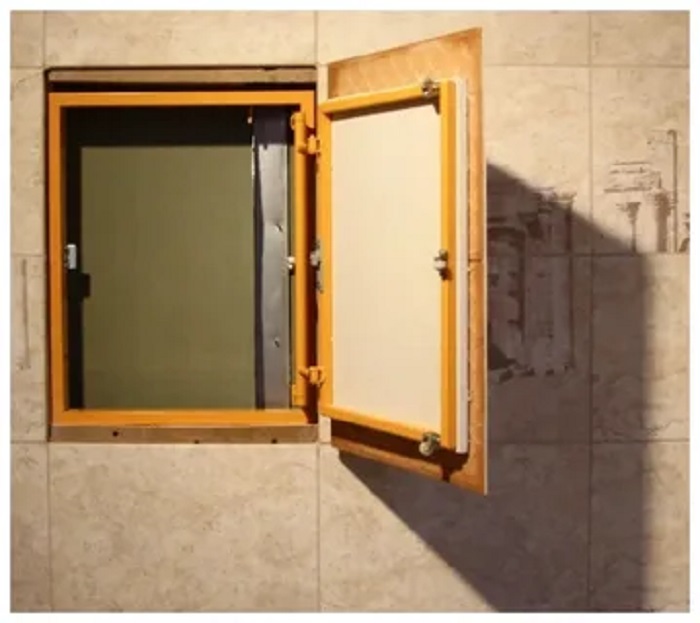
An under-tile access hatch is a concealed inspection structure that allows for servicing utilities (meters, filters, shut-off valves, traps, and manifolds) without dismantling the tile. From the outside, it appears as a continuation of the tile: the seams are aligned, and there are no visible handles or frames.
These solutions access doors and panels are especially popular in bathrooms, toilets, and kitchens, where access to utility systems is required regularly and aesthetics are high. Essentially, it’s a compromise without compromise: a neat interior and a full inspection at any time.
Installing an under-tile access hatch: key steps
- Marking and preparing the niche: determine the location so that the hatch covers the necessary appliances and connections. Check the geometry of the opening, the flatness of the base, and the presence of a rigid frame.
- Frame installation: Secure the frame to the base (profile, brick, concrete, or drywall on a frame) using a level. It is important to avoid distortion, otherwise the door will catch and the seams will “float.”
- Checking the door’s operation: Before installing the door, open and close the door several times to ensure it moves freely and the latches/hinges operate correctly.
- Tiling the door: Apply the tiles so that the pattern and seams align with the overall surface. A slight tile overhang beyond the door edge is acceptable if it is allowed for by the design and does not interfere with opening.
- Creating a technological gap: Leave a neat gap around the door perimeter for the joint to prevent the tiles from rubbing against the frame or chipping when opening.
- Grouting: Grout the joints around the hatch in the same way as on the main wall, but ensure that the grout does not “glue” the contour together. If required by the design, use a flexible compound in the joint area.
- Final adjustment: After the adhesive and grout have dried, test the opening. If necessary, adjust the hinges/latches according to the manufacturer’s instructions.
Common Installation Mistakes
- A frame that is misaligned causes the door to bind and the seams to crack.
- Lack of clearance causes the tiles to chip along the edge every time they are opened.
- Incorrect tiling causes the hatch contours to become visible and the seams to misalign.
- Too heavy tiles without reinforcement cause accelerated hinge wear and door sagging.
Briefly on Compatibility and Purpose
Tile hatches are used in residential and commercial spaces and are often classified as access doors and panels as solutions for discreet access to hidden utility systems. With the right size and proper installation, this type of hatch will last for many years, remaining virtually unnoticeable against the wall cladding.
Unobtrusive access opening in the cladding: aesthetics without visible hardware
An under-tile access hatch allows you to maintain the seamless pattern of the cladding and avoid a visual “break” on the wall or bathtub screen: the access opening remains functional but unobtrusive. The absence of visible hardware, frames, and handles creates a neat and professional finish, especially in small spaces where any detail quickly becomes the focal point.
The aesthetic effect is achieved not only by the type of hatch but also by the quality of installation: the even geometry of the opening, precise tile trim, proper joint placement, and proper adjustment of the opening mechanism. As a result, access to utilities is preserved, and the cladding appears as a single piece.
Results
An unobtrusive inspection is a combination of thoughtful hatch selection and precise installation, which preserves the appearance of a “blind” cladding while allowing quick and safe access to the components.
- Aesthetics: The joints and tile pattern continue without visible hatch boundaries.
- Practicality: Utilities are accessible without removing the trim.
- Durability: Correct tile placement and mechanism adjustment reduce the risk of chipping and warping.
- Versatility: Suitable for bathrooms, kitchens, shower enclosures, bathtub screens, and utility niches.