
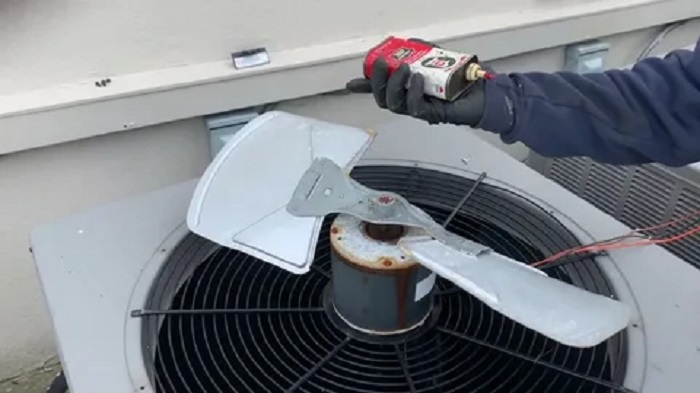
The air conditioner condenser and condenser fan motor work together: the former removes heat from the refrigerant, while the latter ensures airflow and stable heat exchange. If one component fails, the system begins to overheat, pressure rises, cooling capacity drops, and the risk of compressor damage increases.
Replacing the condenser motor and replacing the condenser itself with HVAC repair are different procedures, but the symptoms are often similar. It’s important to correctly determine the cause: sometimes the problem is electrical or contaminated, while other times a full repair is required, including depressurizing the circuit and then recharging.
When is it necessary to replace the condenser fan motor?
The condenser fan motor is responsible for forcing airflow through the heat exchanger fins. With insufficient airflow, pressure in the system increases, the air conditioner cools less effectively, and the compressor operates under more severe conditions.
Typical Signs of Motor Failure
- The fan does not start when the air conditioner is turned on, especially in hot weather or in traffic.
- The fan operates intermittently, stops periodically, or starts with a delay.
- Increased noise, whistling, crackling, impeller play, and the smell of burnt insulation.
- Overheating and pressure increase: the air conditioner cools only at high speeds, but quickly “gives up” when stationary.
Key Steps for Motor Replacement
- Power diagnostics: checking fuses, relays, connectors, control signal, and ground.
- Disassembling the unit: removing the casing/diffuser, impeller, Connector, motor mount.
- Installing the new motor: aligning the mounting locations, securing them, checking the direction of rotation and the absence of wobble.
- Test run: assessing the rotation speed, noise, and stability under load.
If the fan still operates erratically after replacement, check the pressure/temperature sensors, control unit, fan control resistor/module (if applicable), and the condition of the radiator package.
Summary and Quality Control after Replacement
Replacing the condenser fan motor and/or air conditioner condenser should be completed with checks confirming the tightness, proper operation of the fans, and stable pressure parameters in the system. The ultimate goal is to restore efficient heat exchange and prevent repeated overheating, air conditioner shutdowns, and refrigerant leaks.
The result is considered correct if, after assembly, the system reliably reaches the specified operating mode, the air conditioner cools without pressure surges, and the components operate without abnormal noise or vibration. Any deviations are corrected before the vehicle is put into operation.
Final Checklist
- Visual inspection: condenser mounts, housings, guides, no contact with radiators, integrity of honeycomb.
- Electrical: connectors are latched, wiring is not strained and does not touch hot/moving parts, fuses and relays comply with ratings.
- Fan(s): correct start, correct speed, no beating, friction, or extraneous sounds.
- Tightness: check for leaks at connections and components after vacuuming and filling (including through service ports).
- Filling: fill strictly by weight, add oil/UV dye only as needed and as prescribed.
- Diagnostics: monitor line pressure and temperature, no sensor errors Pressure/temperature, correct compressor operation.
- Test drive: check cooling while driving and in traffic, no overheating or spontaneous shutdowns.
- Repeat check after warm-up: inspect connections for sweating/oil residue, check fastener tightness.
Summary: If the correct sequence of operations and final checks are followed, replacing the condenser fan motor and air conditioner condenser ensures stable operation of the A/C system, normal thermal conditions, and minimizes the risk of recurring leaks and overheating.